ABC Weekly
Designing the future of news
Delivering news in an engaging and effortless manner for young Australians amidst a changing media landscape
ROLE
Product Designer
Timeline
Feb - May 2025

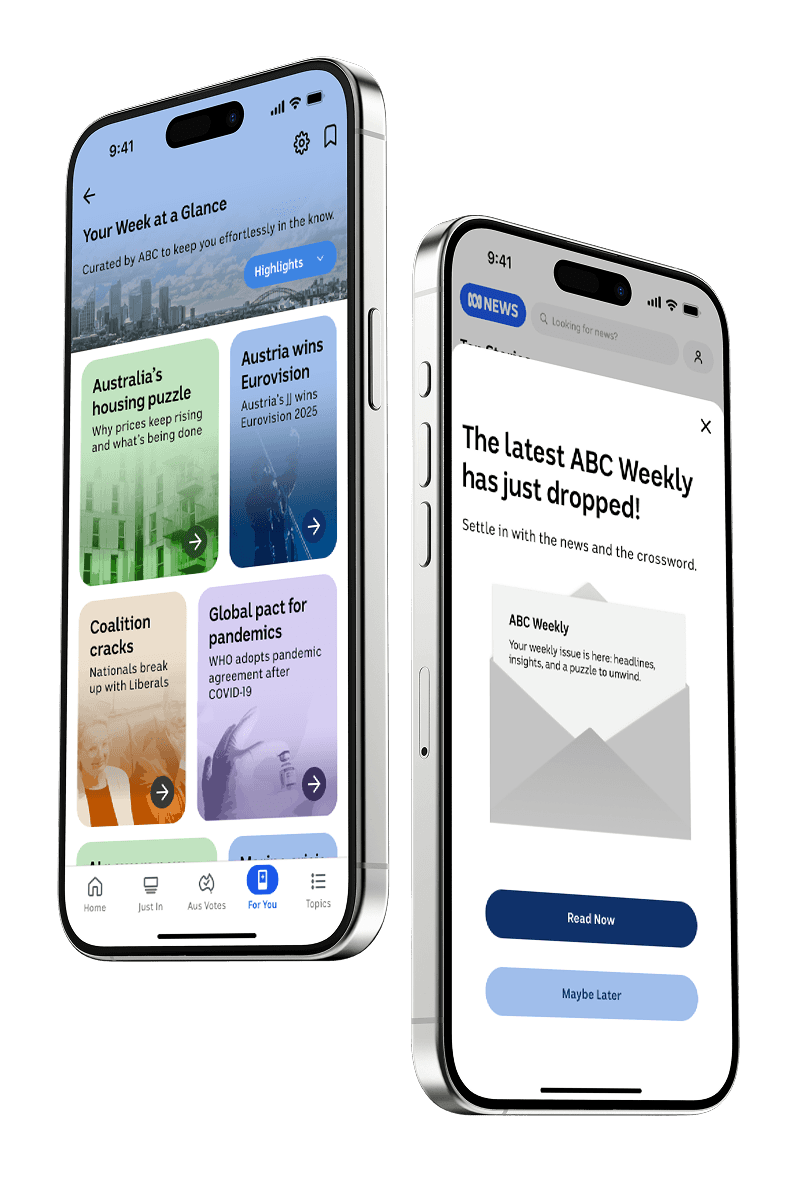
Overview
This is a semester-long project for the IDEA9301 Graduation Studio at the University of Sydney. I worked in a team of four with students from both interaction design and design innovation backgrounds, allowing us to explore the problem and solution space through a strategic lens.
The Brief
The media landscape is undergoing rapid transformation, which significantly impacts how users consume content, particularly for young audiences. The Australian Broadcasting Corporation (ABC) is a cornerstone of reliable news journalism and diverse entertainment for the Australian public, but the traditional role of the ABC is now being challenged by shifting digital habits.
Design challenge: How can the ABC cultivate a healthy lifelong relationship with young Australians by meeting them where they are today while evolving to stay relevant tomorrow?
Our team focused on the area of news avoidance.
The Problem
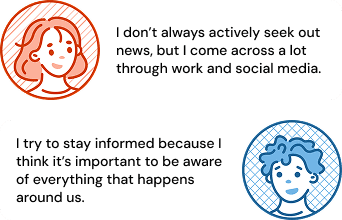
News is overwhelming, depressing, and disengaging
Young people tend to consume news passively
Users want efficiency and convenience
People still have the desire to stay informed
Why news avoidance?
69%
of Australians avoid the news occasionally, sometimes, or often.
(University of Canberra N&MRC, 2023)
Only 36%
of Gen Z in Australia access the news once a day.
(University of Canberra N&MRC, 2023)
Research
To understand young Australians’ attitudes and behaviours when engaging with news, we used the following research methods:
Desktop research: Review studies and reports to understand broader patterns in the current media landscape
Online ethnography: Understand user habits and attitudes through online platforms like Reddit (r/Australia, r/Australian)
User Interviews: In-depth conversations to uncover personal experiences and pain points (19 participants, aged 18-34)
Competitor Analysis: Examine how other platforms engage with young audiences (Social media and other news apps)
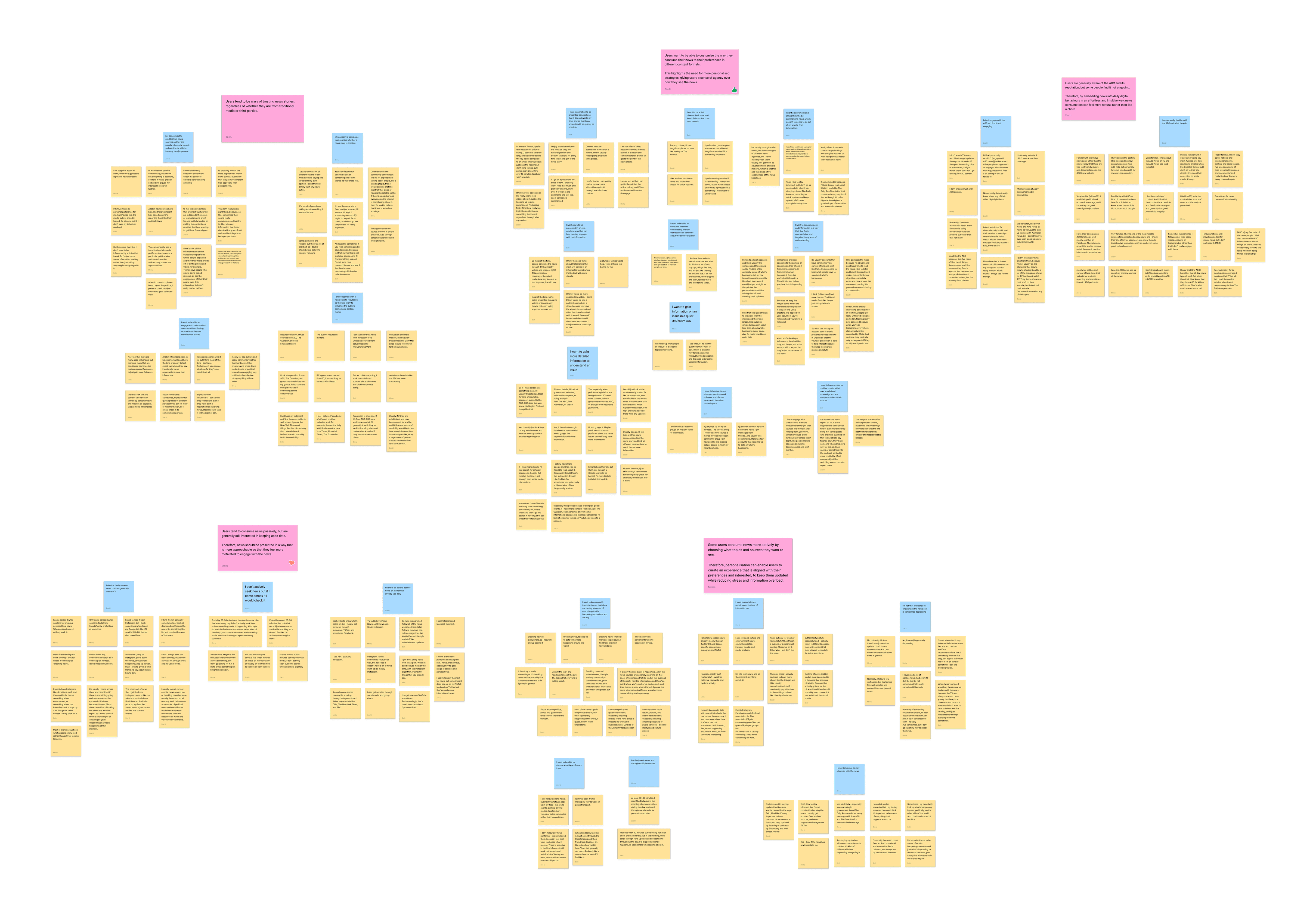
We derived the following key insights, which informed our design direction and approach:
Passive News Consumption
Young people tend to rely on social media algorithms for news. News should be presented in an approachable way so that they feel more motivated to engage with news.
News Fatigue and Scepticism
Young Australians perceive most news overwhelming and depressing, and as a result, they are not motivated to engage with the news.
Desire to Stay Informed
Young people still want to stay up to date with the news, especially when it caters to their areas of interest. Personalisation can enable users to align their experience with their preferences, keeping them engaged.
Personalised Formats
Concise, approachable, and eye-catching formats help maintain engagement amongst young Australians. This highlights the need for more personalised layout options, which give users a sense of agency.
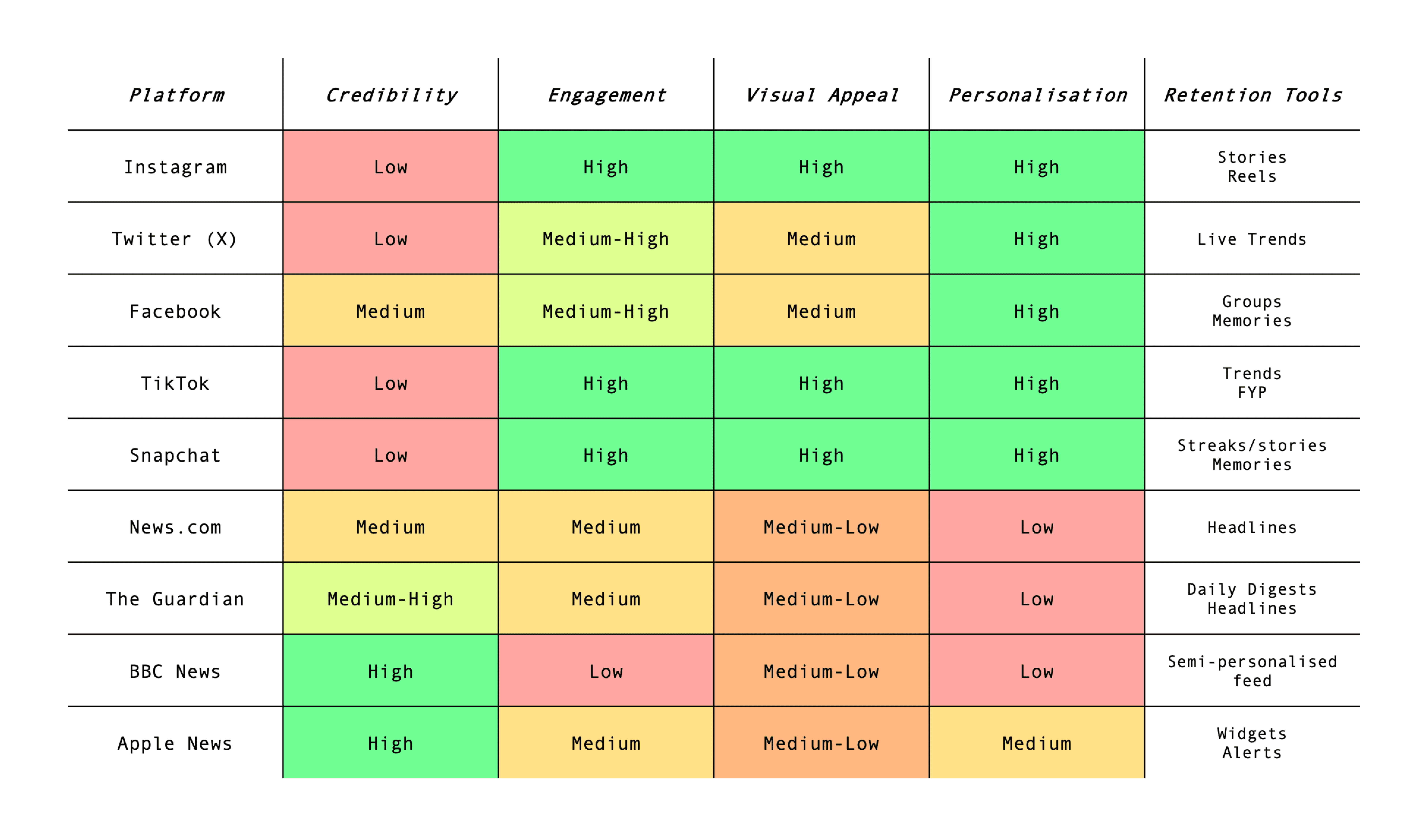
Competitor Analysis
We looked at other news apps and third-party platforms like social media as our main competitors, since younger audiences tend to rely on social media for news. We wanted to explore the appeal of different news platforms and what makes people engage with them, identifying gaps and features to guide our design decisions.
Problem Statement
Young Australians are not motivated to actively engage with traditional news, as they find it boring, depressing, and disengaging. Meanwhile, third-party platforms deliver bite-sized news content directly through algorithms. This has led to a shift toward passive news consumption, where young people keep up with current events without the emotional burden or effort of seeking out traditional news sources.
How might we transform the way ABC delivers news in a way that feels engaging and effortless for young Australians so they can stay informed without feeling overwhelmed?
Ideation
During the initial ideation stage, through methods like crazy 8s and brainwriting, we focused on ideating different engaging and digestible features such as personalised feeds, attention-based formats, interactive quizzes, widgets. However, we realised that those ideas only offer short-term novelty, which led us to shift our focus.
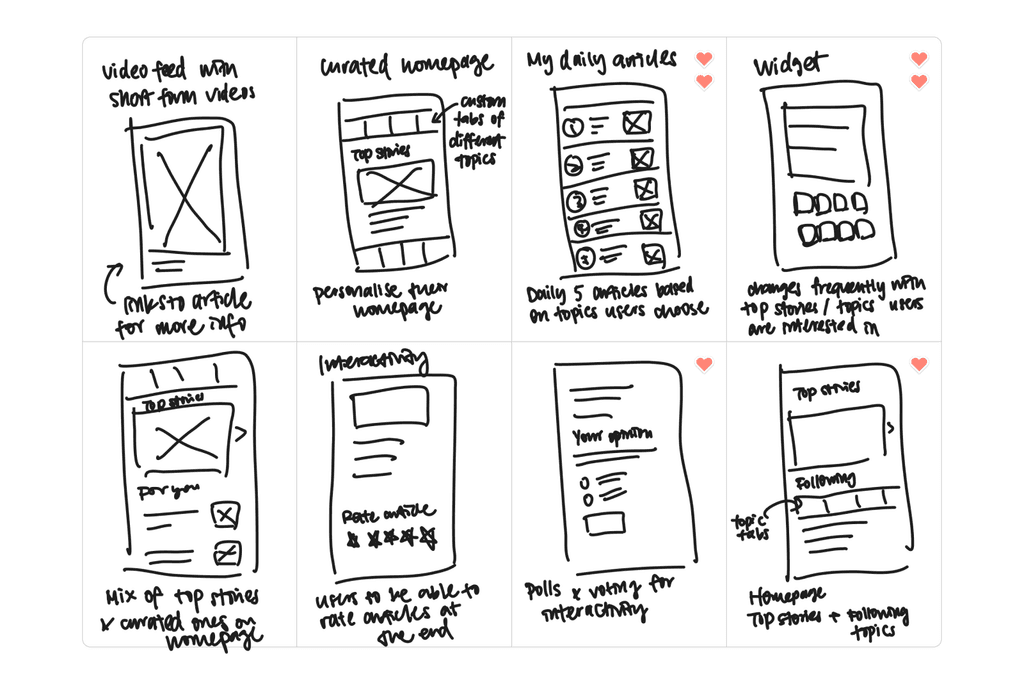
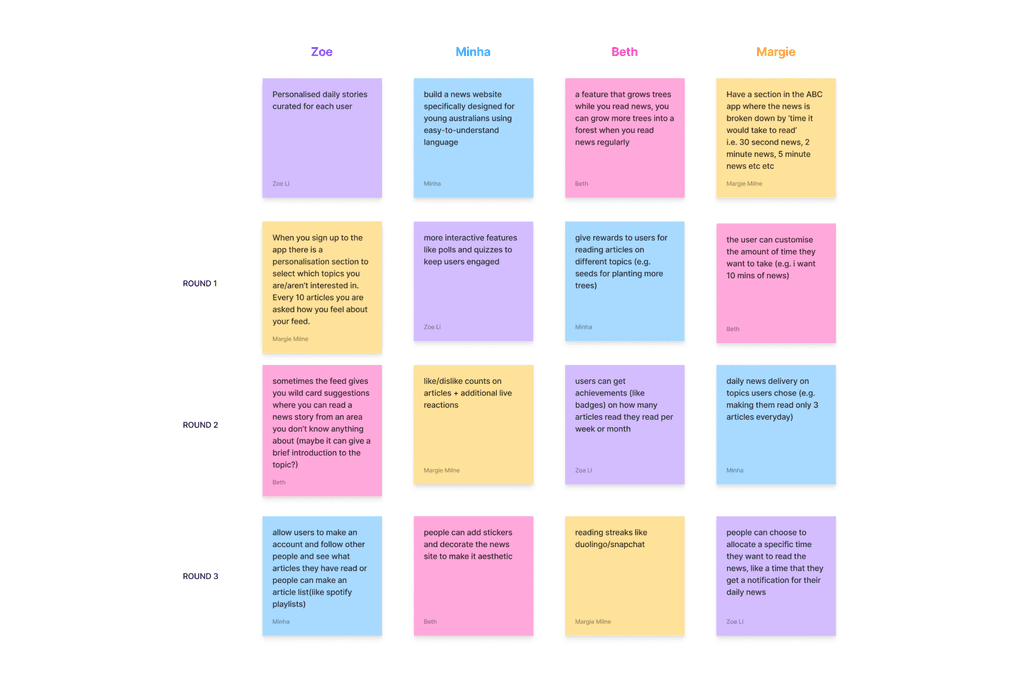
While ideas like reward-based gamification (e.g. points or streaks) initially showed potential for engagement, critical reflection guided by tutor feedback and ABC’s public service values revealed that short-term novelty did not align with ABC’s goal of building a meaningful, long-term relationship with young audiences. We also considered that such features do not provide an overarching solution that truly resonates with users.
Therefore, we gradually shifted toward more intrinsic motivators instead of reacting to surface-level behaviours: what truly drives young Australians to engage with the news? Through quick peer interviews and a review of the data we collected, we identified recurring themes that led us to develop the eight user profiles below.
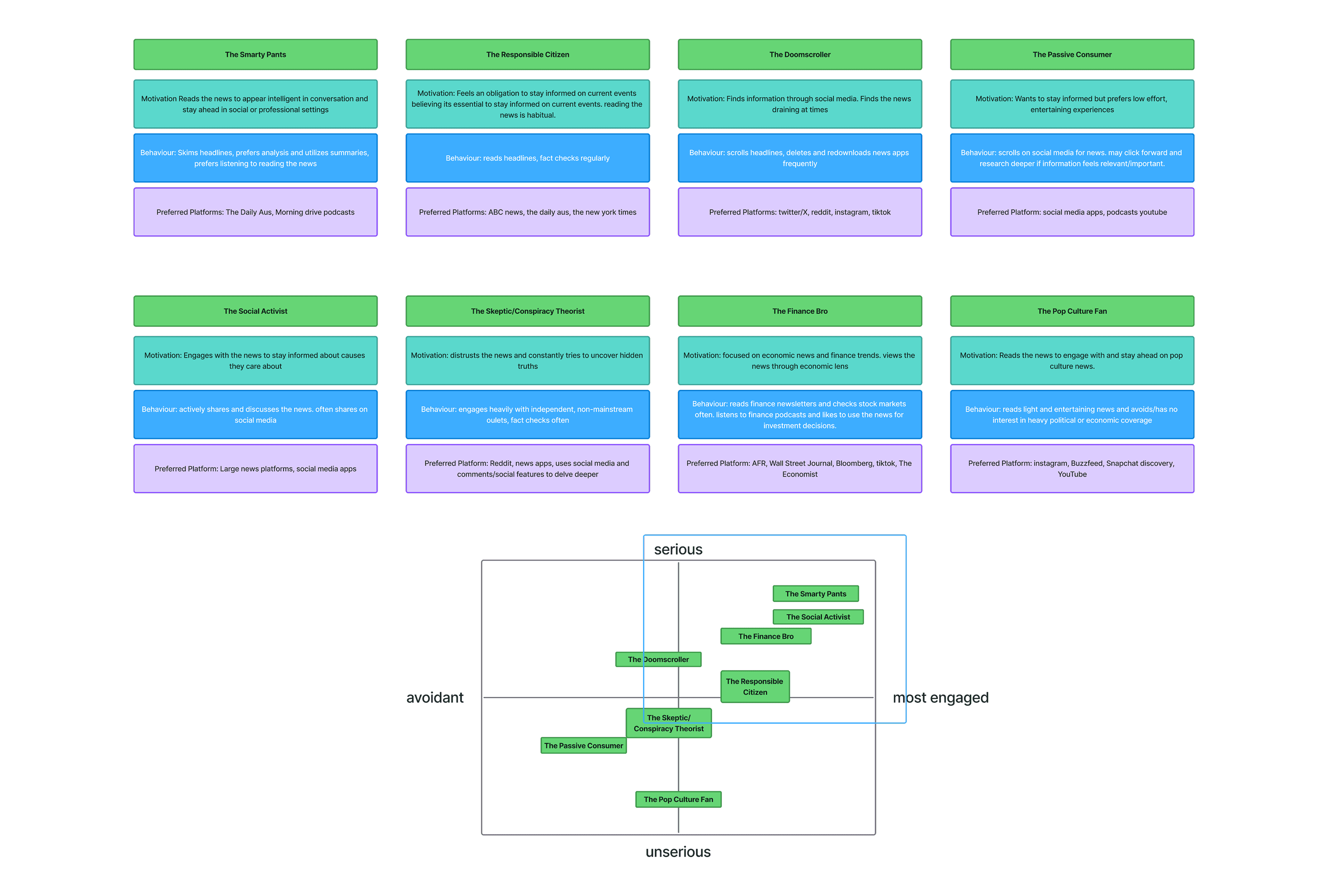
With a broad and diverse audience, we wanted design a solution that is catered to young people who are driven by a genuine desire to understand the world and become responsible, informed citizens but often don’t know where to begin.
Final concept - ABC Weekly
A personalised weekly news digest featuring a simplified and engaging layout, designed to help users stay informed without feeling overwhelmed. Each issue ends with a crossword for users to relax and rewind with some fun, taking a break from negative news.
Why Weekly?
Reduces pressure and the overwhelm compared to daily news.
Builds a habit through light commitment and consistency without taking too much time to make staying informed feel more manageable.
Encourages a more balanced routine, fostering a healthier relationship with news consumption.
Personalisation
Curated topics based on user interests, offering autonomy for users to choose what and how much to read per week.
Personalisation increases user engagement and satisfaction through a more tailored and enjoyable experience.
As users continue to build a habit to read, they can expand their content range as they feel more informed on different topics.
Designed to reduce news fatigue and information overload, by reducing exposure to unwanted or distressing news.
User research showed that people engage more actively with news when they can choose the topics that interest them.
Visual Content
Visual content is more engaging, shareable, and memorable, aligned with how younger audiences engage with content.
By prioritising imagery, headlines, summaries, users can absorb information more quickly and helps to increase understanding of content.
Puzzles
Puzzles can add fun and variety to news, providing a mental break from heavy news. Solutions are also based on recent news, reinforcing users’ knowledge.
Actionable tasks attracts users and keeps them coming back, creating a habit.
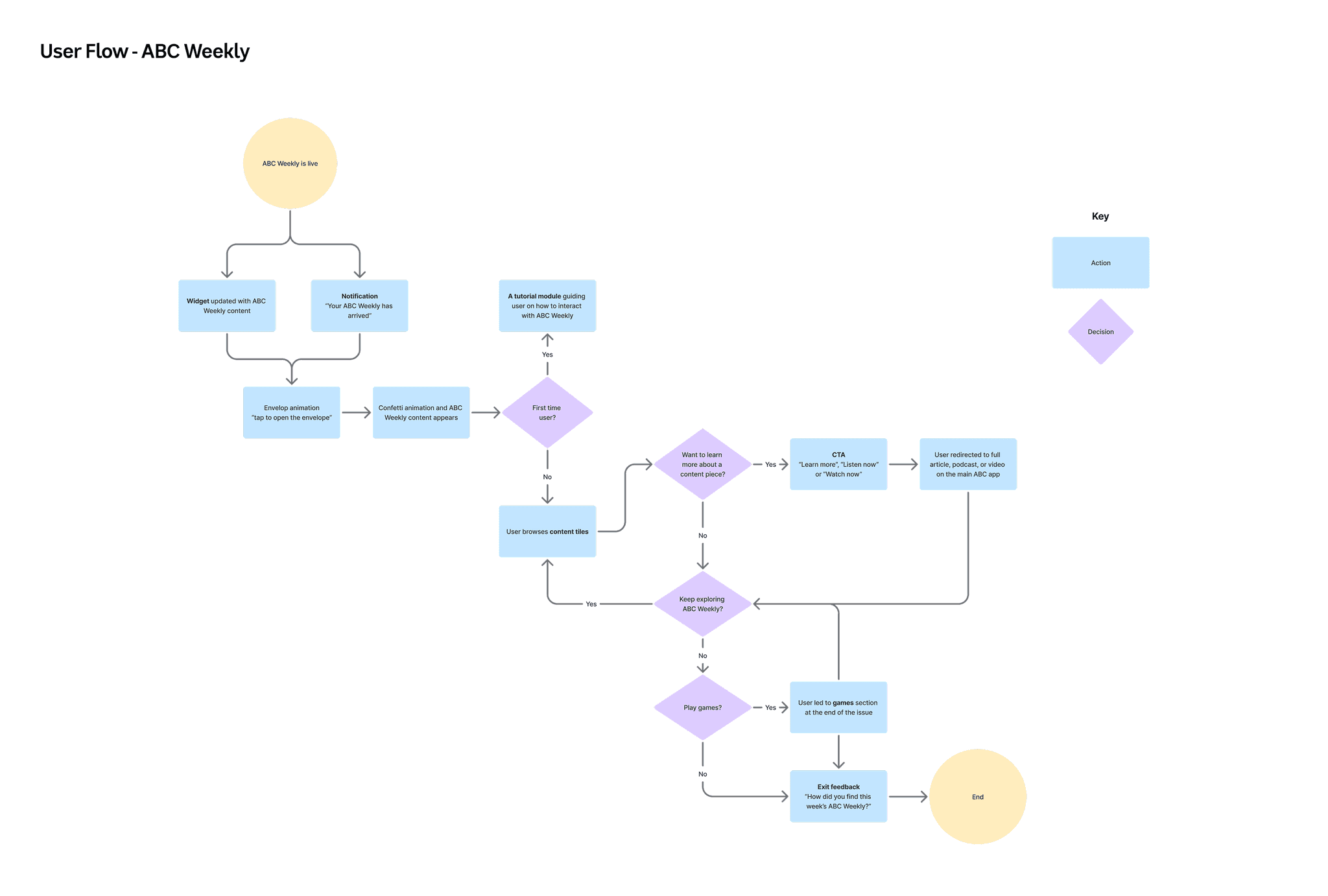
User Flows
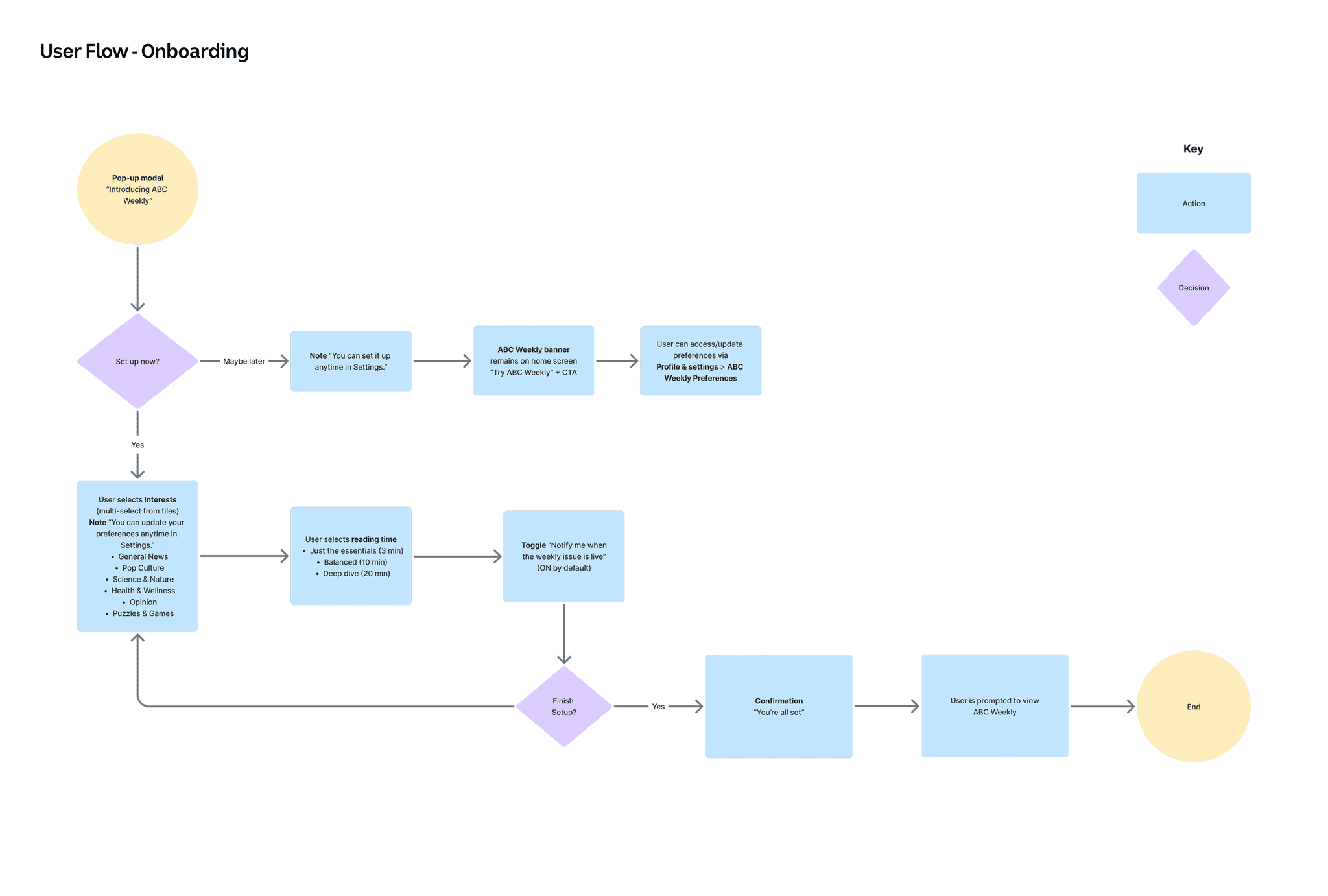
Our solution is part of the existing ABC News app, where we added two user flows:
Onboarding for ABC Weekly - allows users to select their content preferences
ABC Weekly - the weekly news digest that features simplified news articles and a play of the week
Prototyping
Initial Sketches
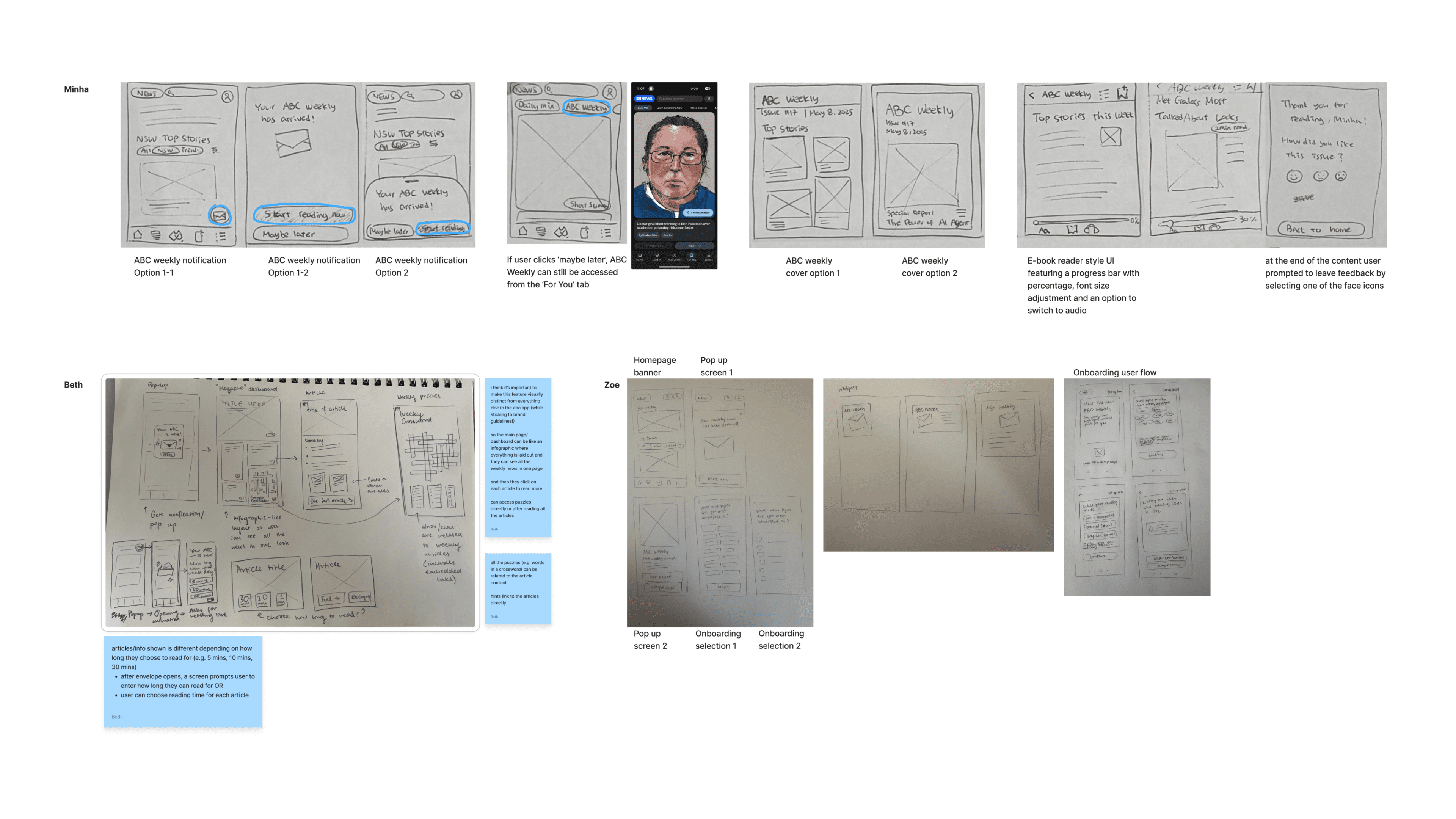
Our sketches visualised the basic layout and functions of the user flows, and we experimented with different layout options before moving on to low-fidelity wireframes.
Low-Fidelity Wireframes
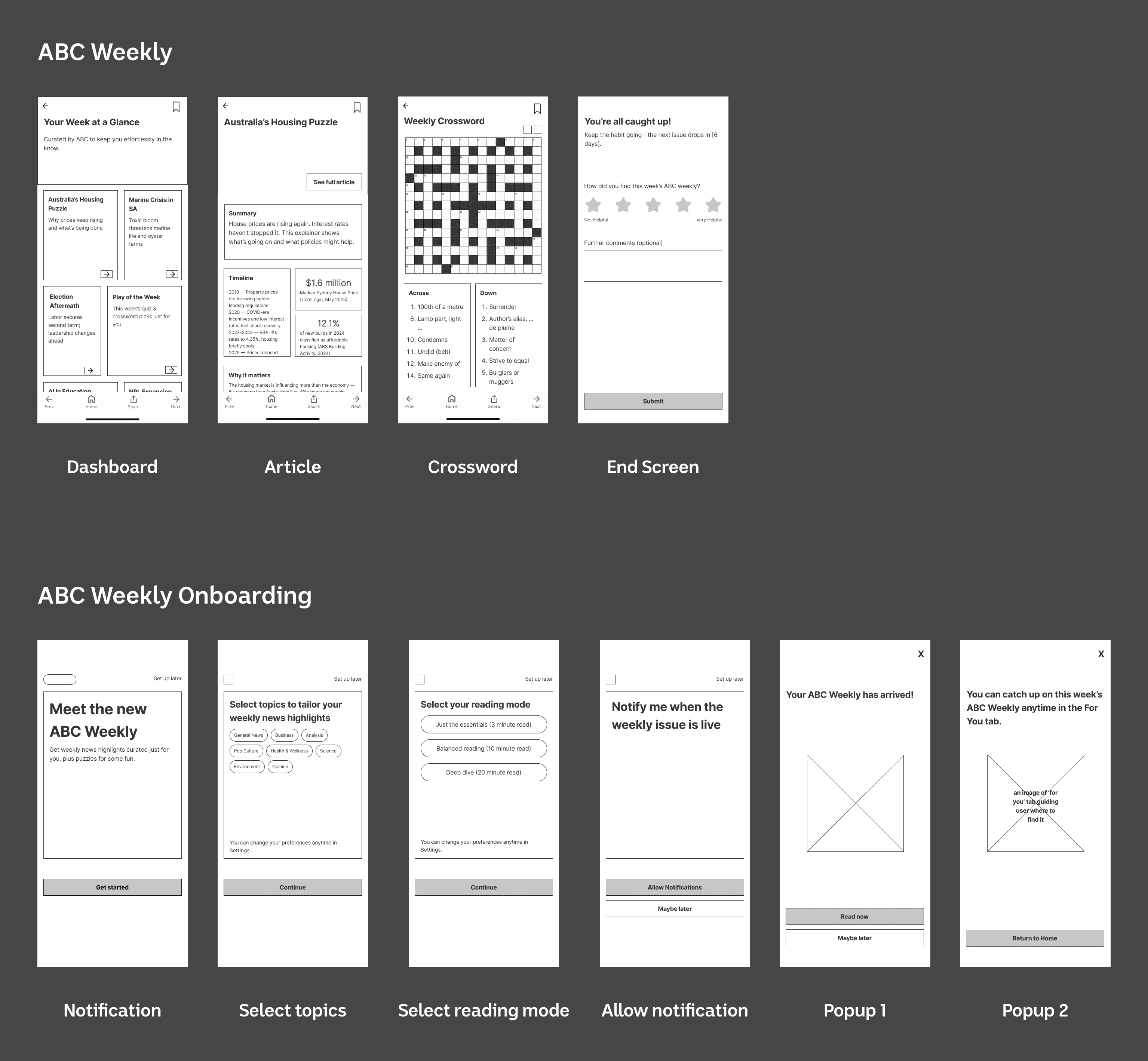
Our low-fidelity wireframes allowed us to test and iterate our ideas from initial user feedback.
Usability Testing
Through usability testing, we aimed to identify pain points and gather feedback to ensure the design is intuitive and aligned with user needs.
Participants
4 users, aged 22-32, participated in the think-aloud user testing. This group represents the app’s target audience, providing insights on its appeal and usability.
Tasks
Participants completed four tasks: complete the onboarding flow, browse the recommended articles, interact with the crossword, and complete the rating end screen. They provided open-ended feedback on their overall experience.
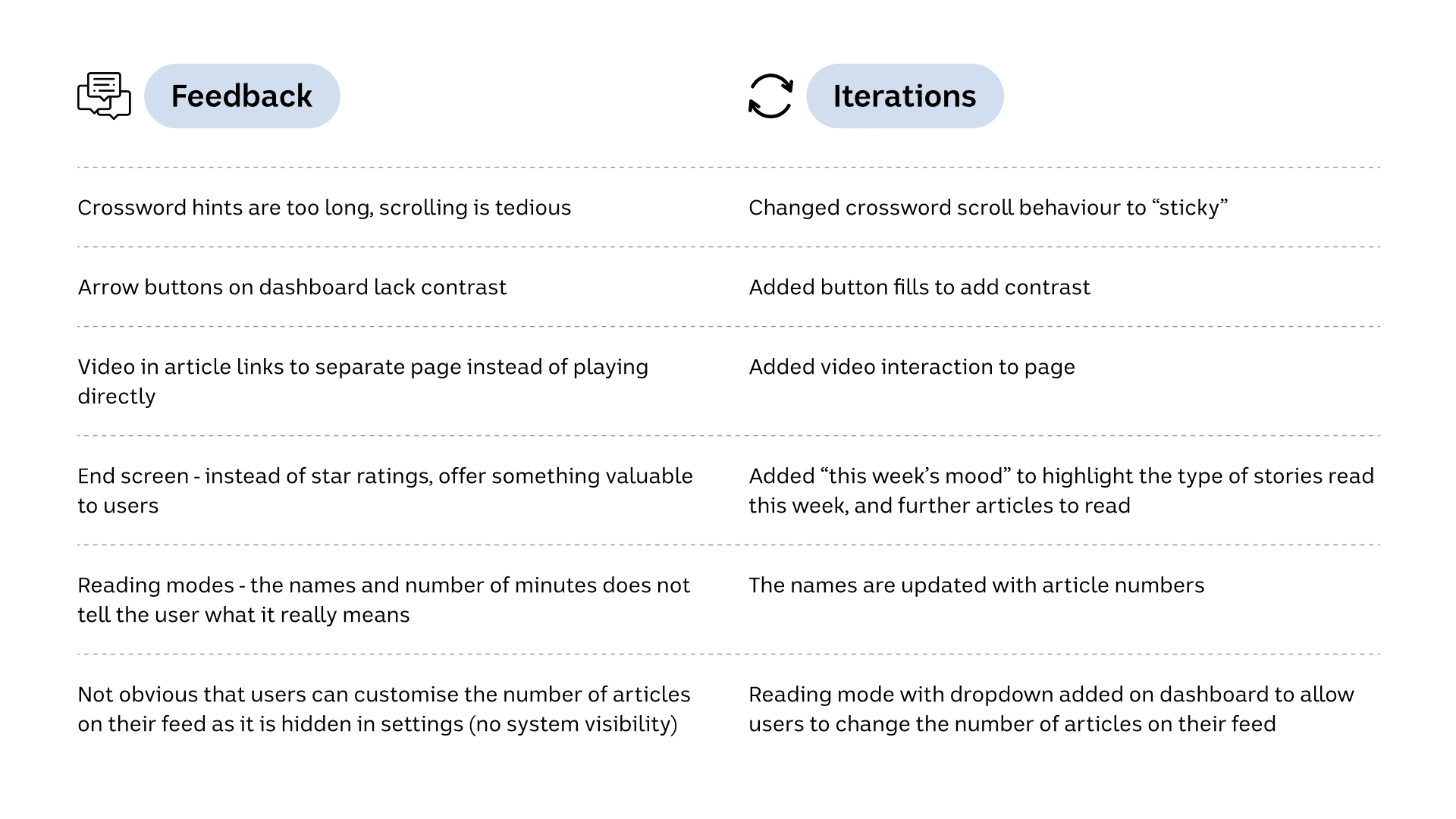
Based on user testing, the below highlights the feedback we received, and the changes we made in response.
Final Solution
Product Demo
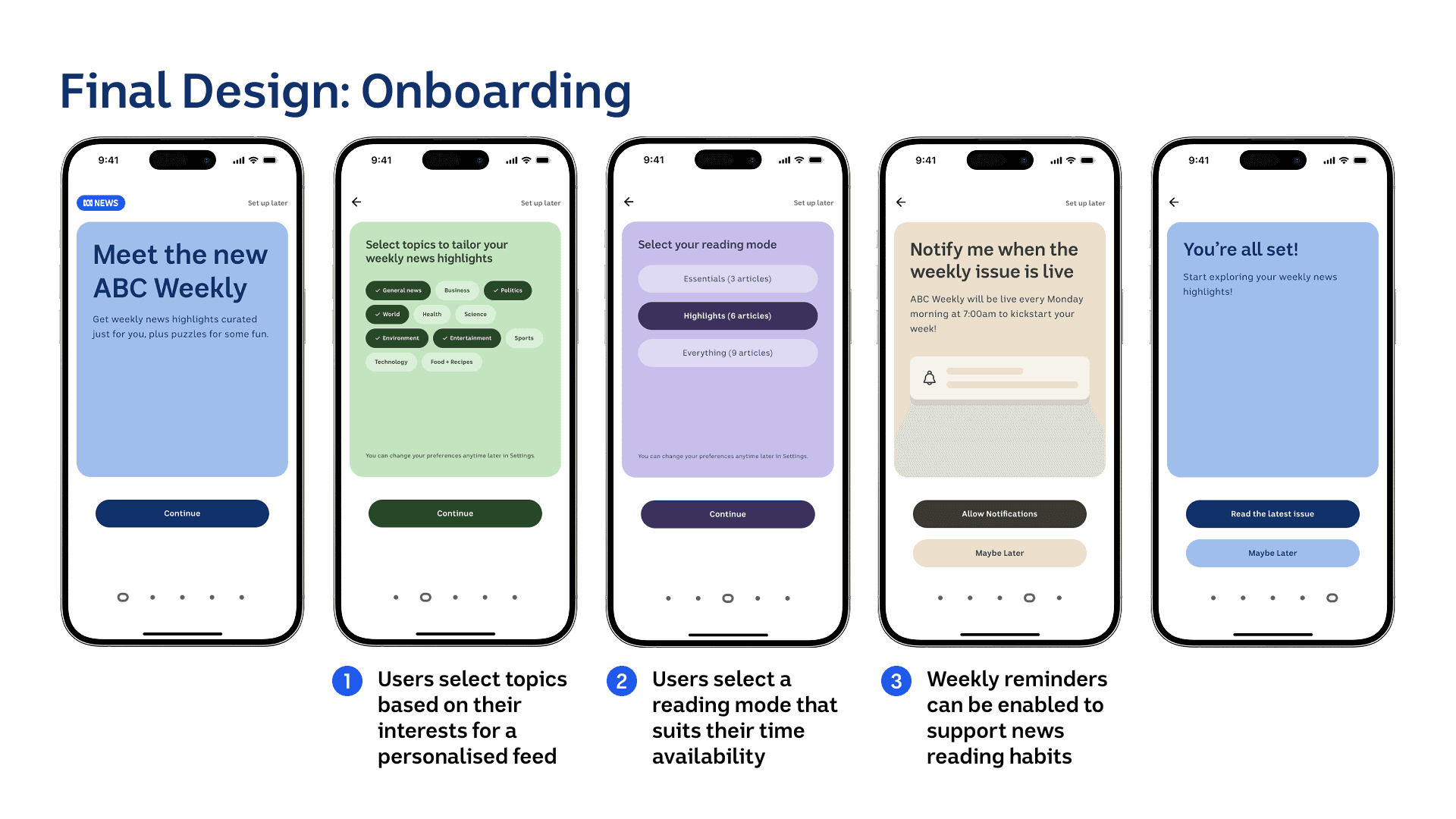
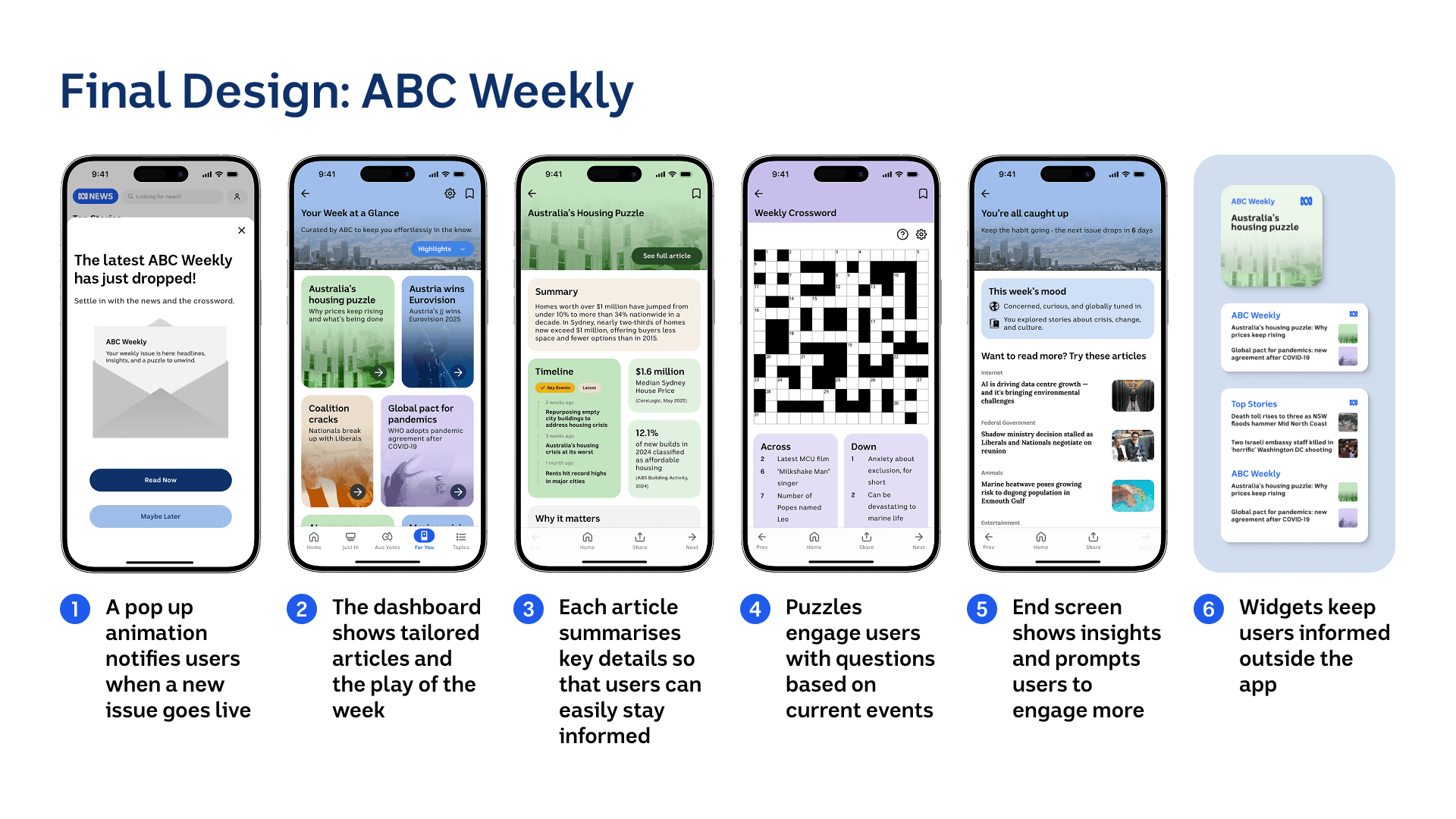
Impact for ABC
Building Loyalty: News organisations that increase user engagement see higher long-term retention and trust through personalising content and creating feedback loops.
Reducing Churn: Personalised onboarding and regular content updates reduce uninstall rates, which is a key issue for ABC News
Broader Reach: Push notifications and widgets increase the "surface area" of engagement by providing a constant touchpoint, for users who might not proactively seek news but are open to casual browsing.
Filling the Gap: The ABC’s 2023 Annual Report mentions a focus on improving digital reach and relevance with younger Australians. This solution directly aligns with that strategic objective.
Marketing Strategy
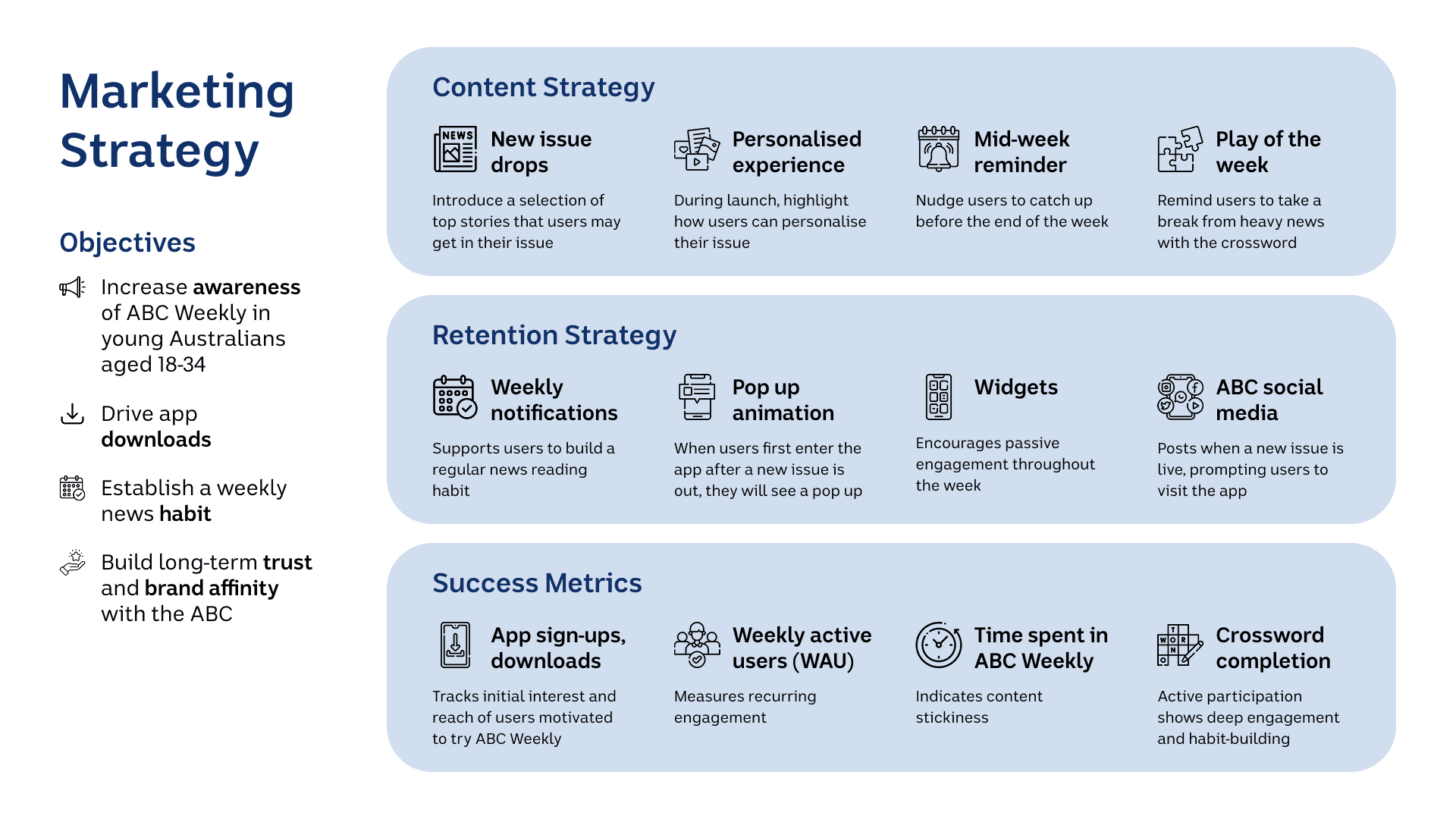
The marketing strategy for ABC Weekly is designed to attract and retain young Australian users by meeting them where they already are, on social media. Along with engaging content and retention strategies, ABC News can also partner with universities and student ambassadors to build trust and increase visibility among new users to boost relatability and credibility among students, making ABC more relevant and trusted.
Learnings & Takeaways
Being able to design for a broad and diverse audience while staying true to the ABC’s public service values. ABC is held to high standards of credibility and impartiality as a tax payer funded organisation, therefore, we had to innovate within the boundaries of public expectations and ABC’s strategic direction through constant reflection, iteration, and open conversation with our stakeholders.
The importance of digging deeper into user motivations rather than just reacting to surface-level behaviours. We wanted our solution to focus on building a long-term habit of news reading and cultivate a strong relationship between young Australians and the ABC rather than short-term gratification through popular trends such as short-form videos, gamification, etc.